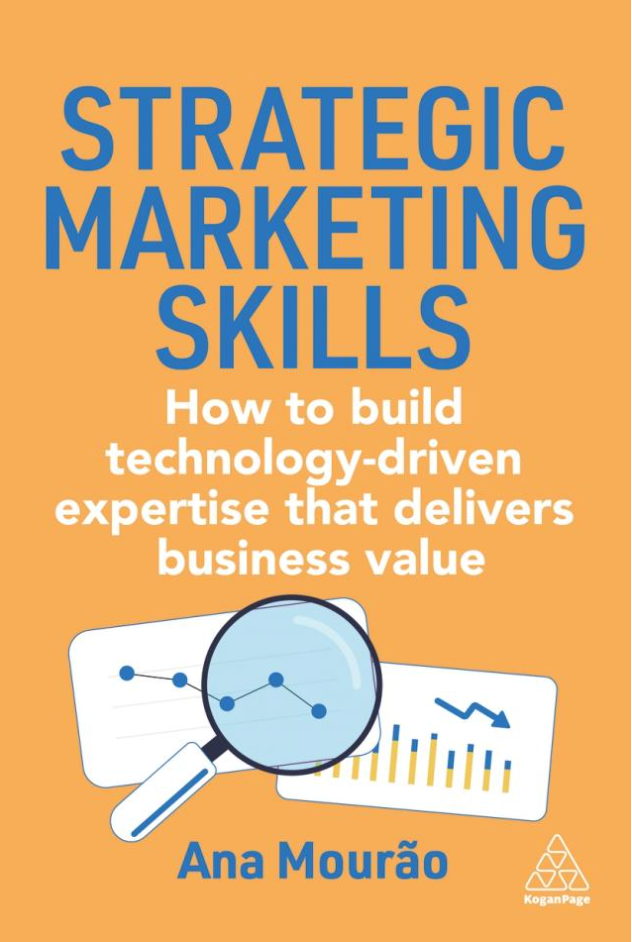
GuideThe marketing skills resume, written around the Eight Es.
Most marketing resumes list tools and adjectives. Hiring managers screen for capabilities — the ability to find something out, move it through an organisation, measure it honestly and explain it to a CFO. This guide takes the eight capabilities from Strategic Marketing Skills by Ana Mourão and turns each one into placement guidance, bullet patterns you can adapt, the keywords applicant tracking systems match on, and the mistake that gets that section skipped.
One rule runs through all of it, and it is the same rule the Antifragile Career Audit enforces: a claim without a named instance is not evidence. If you cannot name the week, the decision or the number, write a smaller, truer bullet.
01Explore on your resume
Strategic Discovery — Identifying Growth Opportunities in Your Marketing Ecosystem
What it signals: Can you find out something the team did not already believe, from primary sources, and act on it?
Where it goesTop two bullets of your most recent role, plus a 'Research & insight' line in your skills block.
Bullet patterns to adapt
- Ran 24 customer discovery interviews and a stack audit that surfaced a mis-tagged checkout event, correcting reported conversion by 18% and redirecting £340k of planned spend.
- Mapped first-party data across CRM, CDP and support tooling; identified 3 usable audience signals that had never been activated, cutting prospecting CPA by 22%.
- Replaced a vendor-supplied market sizing with a bottom-up model built from internal transaction data, changing the 2025 category entry decision.
Numbers are illustrative. Replace them with yours — an invented figure fails in the interview, not on the page.
Keywords that get matched
customer researchmarket analysisfirst-party datamartech auditcompetitive intelligencevoice of customer
The mistake
Listing tools you have logged into. 'Familiar with GA4, Segment, Looker' is not discovery — name what you found and what changed because of it.
02Engage on your resume
Building Stakeholder Buy-In and Cross-Team Collaboration
What it signals: Can you move work through an organisation that does not report to you?
Where it goesLeadership bullets in each role — even in individual-contributor titles.
Bullet patterns to adapt
- Aligned sales, RevOps and finance on a single pipeline definition, ending a two-year reporting dispute and shortening monthly close from 9 days to 3.
- Built and chaired a cross-functional growth forum (marketing, product, CS) that shipped 11 joint experiments in 12 months with no added headcount.
- Secured engineering capacity for a consent-management rebuild by reframing it as a churn-risk case for the CFO rather than a compliance ask.
Numbers are illustrative. Replace them with yours — an invented figure fails in the interview, not on the page.
Keywords that get matched
stakeholder managementcross-functional collaborationexecutive buy-ininternal communicationsinfluencing without authority
The mistake
'Excellent communicator' and 'team player'. Both are unverifiable. Name the stakeholders and the decision you moved.
03Exchange on your resume
Collaborative Iteration
What it signals: Can data, budget and accountability move across boundaries without breaking?
Where it goesOperations and systems bullets; a dedicated 'Marketing operations' skills line if the role is ops-weighted.
Bullet patterns to adapt
- Designed a lead-handoff SLA and shared taxonomy between marketing and sales, lifting MQL-to-SQL acceptance from 41% to 73%.
- Negotiated a data-sharing agreement with two agency partners, replacing monthly spreadsheet exports with a governed pipeline into the warehouse.
- Introduced a quarterly budget reallocation ritual with finance, moving 15% of spend to better-performing channels mid-year instead of at renewal.
Numbers are illustrative. Replace them with yours — an invented figure fails in the interview, not on the page.
Keywords that get matched
marketing operationsdata governanceSLA designvendor managementprocess improvementrevenue operations
The mistake
Describing the tool migration but not the agreement. Systems get replaced; the operating agreement you wrote is the transferable skill.
04Experiment on your resume
Building Measurement Systems that Enable Strategic Testing
What it signals: Do you run tests where you genuinely did not know the answer — and do you stop things?
Where it goesOne bullet per role minimum. Include at least one thing you killed.
Bullet patterns to adapt
- Built a testing roadmap of 40 experiments across paid and lifecycle; 12 shipped to production, 9 were stopped on the evidence, saving an estimated £120k in annual run cost.
- Introduced pre-registered hypotheses and minimum detectable effect sizing, cutting inconclusive tests from 60% to 18% of the programme.
- Ran a geo-holdout on brand spend that showed a 1.9x incremental ROAS, replacing last-click attribution as the budget basis.
Numbers are illustrative. Replace them with yours — an invented figure fails in the interview, not on the page.
Keywords that get matched
A/B testingexperimentationincrementality testingmarketing mix modellingstatistical significancegrowth experimentation
The mistake
Only reporting wins. A page of unbroken success reads as selection bias; naming a shutdown decision is the strongest credibility signal you have.
05Embrace on your resume
Adapting to Constant Change and Building Agile Marketing Systems
What it signals: What did you do when the ground moved — absorb it, or gain from it?
Where it goesYour career-narrative summary at the top, plus bullets covering reorgs, platform changes and AI adoption.
Bullet patterns to adapt
- Rebuilt measurement after the deprecation of third-party cookies, standing up server-side tracking and modelled conversions ahead of the deadline with no reporting gap.
- Led adoption of generative AI in the content workflow: defined review gates and quality bar, tripling output volume while holding editorial rejection rate under 10%.
- Retired a legacy nurture programme I had built, replacing it with behaviour-triggered journeys that lifted pipeline contribution 31%.
Numbers are illustrative. Replace them with yours — an invented figure fails in the interview, not on the page.
Keywords that get matched
change managementAI adoptionagile marketingprivacy-first measurementtransformationresilience
The mistake
Framing change as something that happened to you. 'Navigated a restructure' is passive; say what you moved toward.
06Everything on your resume
Measuring, Explaining, and Connecting Marketing to Business Objectives
What it signals: Can you connect marketing to business economics without a translator?
Where it goesEvery quantified bullet in the document, and the two-line summary at the top.
Bullet patterns to adapt
- Owned a £4.2m annual budget against a contribution-margin target, delivering 112% of plan while reducing blended CAC 17% year on year.
- Replaced MQL volume with pipeline-to-spend ratio as the executive marketing KPI, giving the board a metric it could compare with other investments.
- Built the payback model used in the Series B deck, showing 11-month CAC payback across two segments.
Numbers are illustrative. Replace them with yours — an invented figure fails in the interview, not on the page.
Keywords that get matched
CACLTVROIpipeline contributionbudget ownershipP&Lforecastingattribution
The mistake
Vanity metrics. Impressions, followers and open rates do not survive a CFO's follow-up question; use money, time or risk.
07Explain on your resume
Translating Marketing Value into Organizational Currency
What it signals: Can other people restate your argument correctly when you are not in the room?
Where it goesThe resume itself is the exhibit. Also: a 'Selected work' section linking talks, docs or frameworks you authored.
Bullet patterns to adapt
- Authored the internal measurement handbook now used by 40+ marketers across three regions as the standard for test design and reporting.
- Presented quarterly performance to the executive committee; the segmentation model I introduced is now the shared language for planning.
- Taught a six-week analytics clinic for non-technical marketers; 85% of attendees shipped their own dashboard within a quarter.
Numbers are illustrative. Replace them with yours — an invented figure fails in the interview, not on the page.
Keywords that get matched
executive reportingdata storytellingenablementdocumentationpublic speakingstakeholder communication
The mistake
A resume that needs you present to make sense. If a recruiter cannot repeat your value proposition after eight seconds, the Explain section has failed on its own terms.
08Evolve on your resume
Engineering Your Marketing Career in the Age of AI and Constant Change
What it signals: Is your capability portfolio still compounding, or living off one good year?
Where it goesA short 'Continuous development' block at the bottom — dated, specific, no filler certifications.
Bullet patterns to adapt
- Maintain a public write-up cadence on measurement practice; 3 pieces cited in industry newsletters in the last 12 months.
- Completed a hands-on SQL and warehouse modelling programme, now writing my own attribution queries rather than briefing them.
- Advise two early-stage founders on go-to-market, which keeps me testing the framework outside my own category.
Numbers are illustrative. Replace them with yours — an invented figure fails in the interview, not on the page.
Keywords that get matched
continuous learningprofessional developmentthought leadershipmentoringcareer portfolio
The mistake
A wall of undated course badges. Two dated, applied items beat ten certificates nobody will ask about.
Before you rewrite the page
Find out which E is actually weakest.
The Antifragile Career Audit scores seven of the eight capabilities, applies the same named-instance rule used above, and tells you whether disruption leaves you weaker, unchanged or better. Rewrite the resume around the answer. Nothing leaves your browser.